#TheExecutionGap XEROX DIDN'T MISS THE FUTURE. IT REFUSED TO SIGN FOR IT.
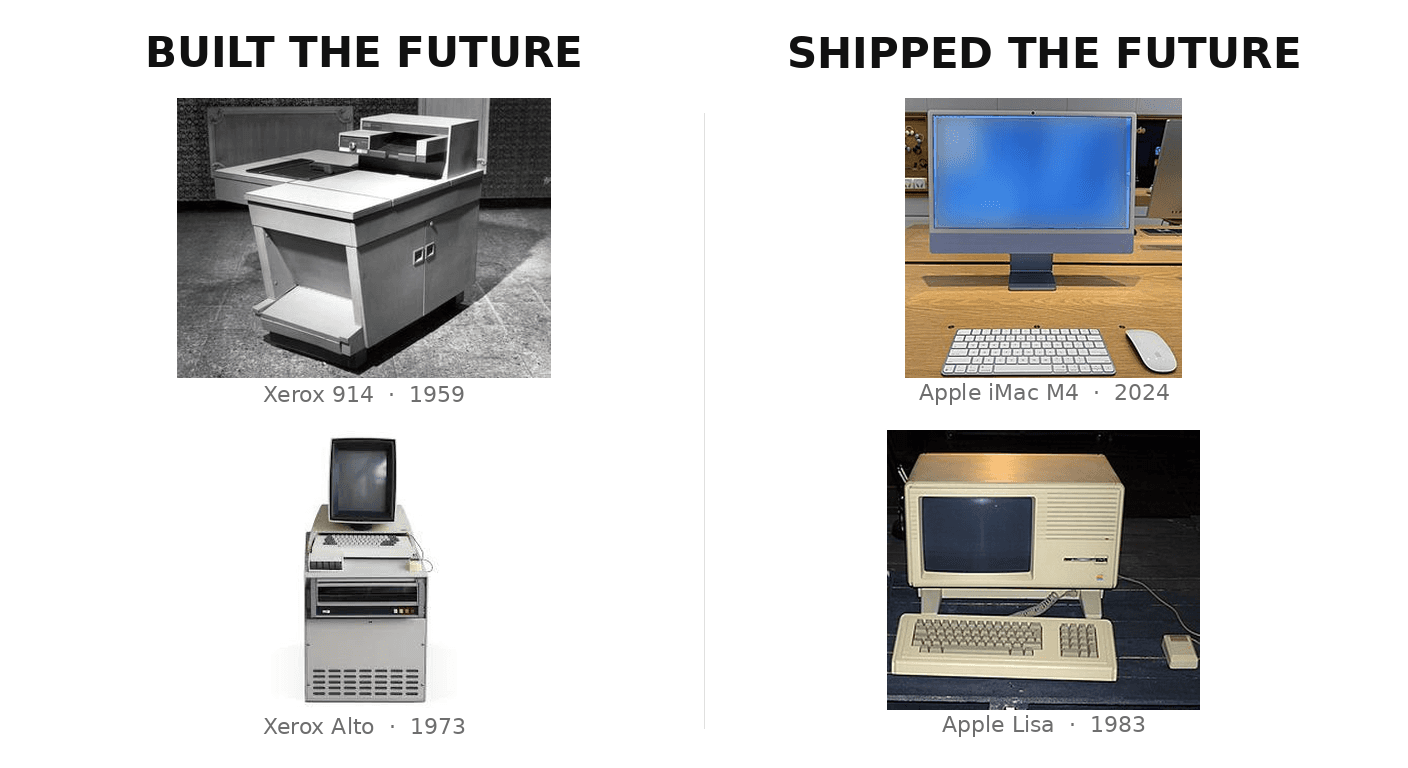
In 1973, Xerox built the mouse, the graphical interface, and the personal computer.
Then sold Steve Jobs a look at all three for $1M.
The Alto was the first PC with a graphical screen, a mouse, and a network, eight years before IBM's PC.
Its builders warned headquarters immediately: this was the office of the future. Sell it, or someone else will.
✅ Urgency travels only as fast as someone senior is willing to feel it.
The Alto wasn't hidden. Its builders demoed it, defended it, pushed it upward, for years.
No one senior treated it as an emergency instead of a curiosity.
Executives kept running the copier business as before.
John Kotter later spent decades naming this pattern. Inside Xerox, it was just Tuesday.
By 1979, that hesitation had cost eight years.
Xerox let a small Apple team spend three days inside the lab, in exchange for $1 million in pre-IPO Apple stock.
Jobs left already rebuilding Apple's roadmap. Lisa shipped in 1983, the Macintosh a year later.
Both were born that afternoon.
Two years later, Xerox launched its own version, the Star. It flopped.
Not for worse technology.
Because whoever priced and positioned it never saw what Jobs saw in an afternoon.
✅ The advantage was never invisible. It was invisible to the wrong person.
PARC insiders called Rochester's executives "toner heads," a nickname that says whose judgment decided the Star's fate.
Everett Rogers later used this exact case to argue that adoption depends less on being better, more on the decision-maker perceiving it as better.
That wasn't stupidity. It was structure.
✅ Protecting the business that pays the bills isn't a mistake. It's the incentive working as designed.
Xerox's sales force, bonuses, and profit model ran on copiers.
A $1 million stock buy cost nothing, touched nothing, easy yes.
Restructuring to compete with its own copier division was neither easy nor rewarded.
Clayton Christensen later named this the incumbent's dilemma:
Resources flow to what already pays, and starve what threatens it, even one floor down.
Three separate failures would be a coincidence.
One organization, one decision, examined three times, is a system.
The next Xerox won't fail from blindness. It will fail doing exactly what its system rewards.
Most transformation post-mortems blame the roadmap.
The roadmap almost never is.
Nobody owned the moment the advantage became visible, and the incentives rewarded looking away.
If the next Alto is sitting in your building today, who has the authority, the perception, and the incentive to walk it out before a competitor does?
Xerox didn't miss the future. Its own organization refused to sign for it.
#TheExecutionGap · Layer 2, Digital Transformation · 2.1, DT Why
#DigitalTransformation #OrganizationalGovernance #ChangeManagement #OriacGimeno