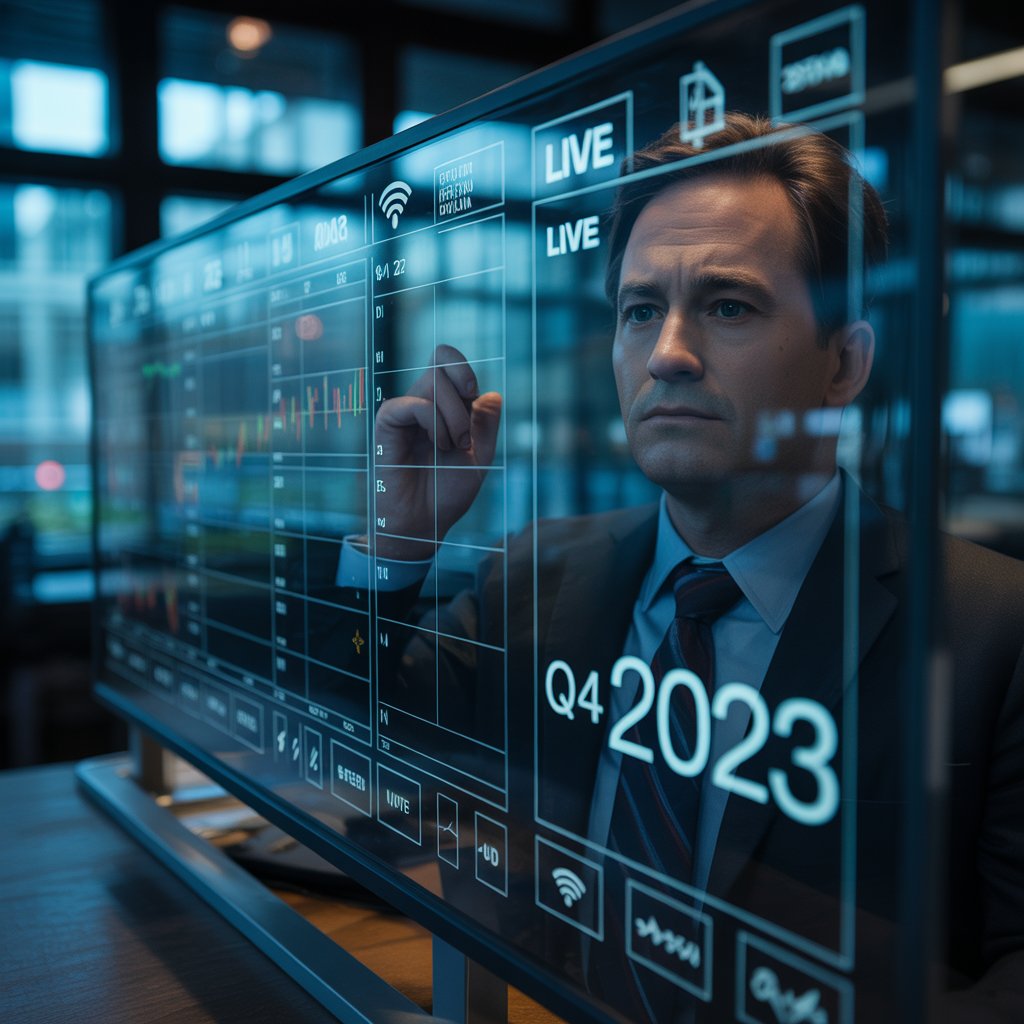

We read 2026 market data. Its decision logic was written 2 years ago.
A high-precision instrument pointed at the wrong year.
Most commercial committees haven't noticed the gap — and the tools aren't built to flag it.
There's a critical difference between an AI that reads current information and one whose decision logic is current. Models like GPT-4o or Llama 3 may have broad context windows, but their weight architecture — the neural layer that decides what's a good lead, what's a risk, what's worth pursuing — is static. Those weights were forged in a world of low interest rates, intact supply chains, and pre-consolidation competitive maps. Feeding them today's data doesn't update their judgment. It gives them more recent examples to interpret through a 2023 lens.
Three mechanisms already running in the pipeline:
🔮→⏮️ Probabilistic anchoring. The model doesn't predict what will happen. It calculates the probability of what should happen — based on patterns it was rewarded for in training. After a structural market break, those patterns describe a world that no longer exists. The bias isn't in the data feed. It's in the architecture.
🧬→🧬 Algorithmic inbreeding. When a scoring model is instructed to find leads "similar to our best accounts," it doesn't expand the funnel — it clones the past. It has no mechanism to recognize what's starting to work. As Andrew Ng has argued, the real production problem isn't model quality — it's the static definitions of "good" baked into training data. Every refinement makes the model more precise at missing the same opportunities.
🌐→🎯 Superstar bias. As Erik Brynjolfsson has documented, models trained on historical success structurally skew toward established players, known channels, proven patterns. The scoring doesn't push toward high-margin opportunity — it pushes toward the most competed ground, because that's the only geometry it was trained to recognize as safe. We compete harder into exactly the markets where the margin already left.
The combined result: a high-precision instrument pointed at the wrong year.
That's not a data problem. That's not a model problem.
It's what happens when we mistake processing speed for strategic judgment.
Unpopular opinion: "Our AI has web access" doesn't answer model drift. Real-time data fed into static weights doesn't update judgment — it updates the examples used to reach the same conclusions.
How many accounts in the discard pile are the growth relationships of 2026 — and what in the current setup would ever flag them as anything other than noise?
The mechanism behind #TheParetoCollapse — part 1 of 3.
#TheParetoCollapse #BusinessDevelopment #AIGovernance #CommercialStrategy #DataDriven #ContinuousLearning #OriacGimeno