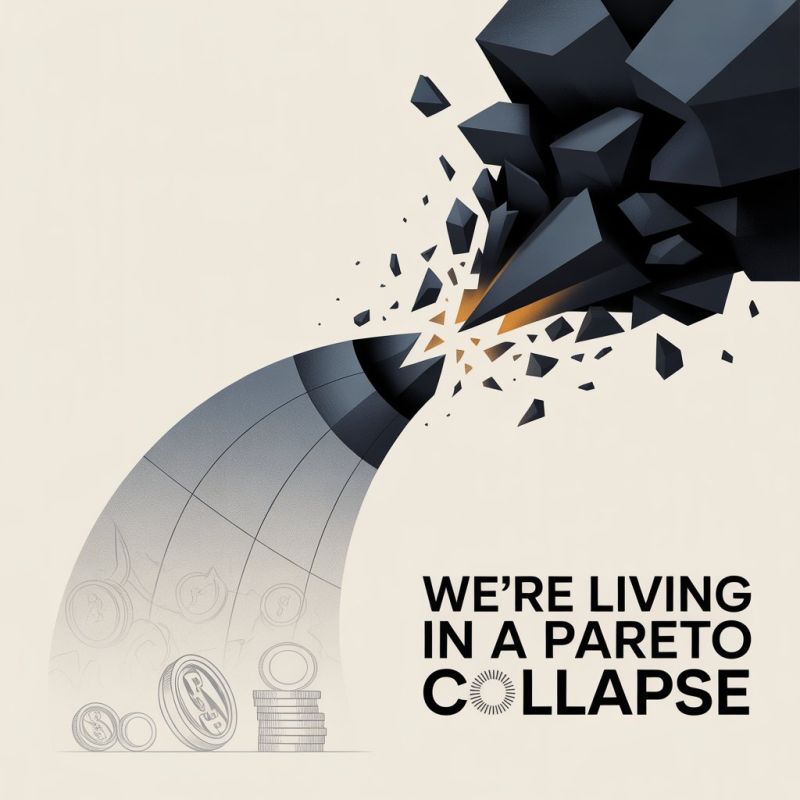
We're not living in a Pareto economy. We're living in a Pareto Collapse.
And we're still running commercial strategy on a model from 1896.
Pareto's 80/20 rule lives in our scoring models, segmentation frameworks, and forecasting tools. It's become invisible—which is when assumptions get dangerous. The math underneath it no longer holds.
Three things broke the model. Quietly. Simultaneously.
📈→🧱The Lorenz Curve stopped being a curve.
In an economy of superstar firms and autonomous agents, value distribution no longer follows a curve. It follows a right angle. We've moved from "the winner takes most" to "the winner absorbs the ecosystem." The mechanism isn't merit — it's compounding. The firms dominating today didn't out-execute the market; they accumulated digital advantage early and scale without friction. Growth strategies designed for a curve that flattened years ago are where margin quietly disappears.
🧲→🌀The Matthew Effect got an algorithm.
"To those who have, more will be given." A sociological observation until AI turned it into operational logic. Return on existing capital — data, relationships, success patterns — now grows structurally faster than return on new exploration. It's not a bias in the algorithm. It's the geometry of the system. Models trained on historical success don't just identify winners; they manufacture them. The Gini coefficient of our own pipelines is compounding in silence, while the next high-growth market goes undetected by design.
🔍→🌫️The false negative is now the most expensive number in the P&L — and no one is measuring it.
Most AI deployed in commercial functions isn't expanding market reach. It's optimizing what we already knew — faster. Economists have a name for this: technology that automates without creating new value. In BizDev: a scoring model rejecting leads our segmentation was never built to recognize. Every competitor's algorithm makes the same call on the same training data. That ignored 90% isn't noise — it's the only place where asymmetric opportunity still lives. And it's invisible by construction: absence of leads never shows on a dashboard. It shows up years later, as a competitor we missed.
The paradox: the same technology that promises efficiency is accelerating concentration. Without judgment in the loop, AI doesn't help us grow faster. It helps us saturate faster—in crowded markets.
Unpopular opinion: presenting the 80/20 rule in a 2026 boardroom isn't strategy. It's pattern recognition that stopped updating—and someone in the room already knows.
Piketty called it r > g. Acemoglu, so-so technology. Brynjolfsson, superstar firms.
I'm calling it the Pareto Collapse—because we're the ones building strategy on top of it.
The uncomfortable question isn't whether Pareto still works:
Who in our organizations is paid to notice the geometry? And who decides what counts as noise?
#TheParetoCollapse #BusinessDevelopment #CommercialStrategy #DataDriven #AIGovernance #OriacGimeno