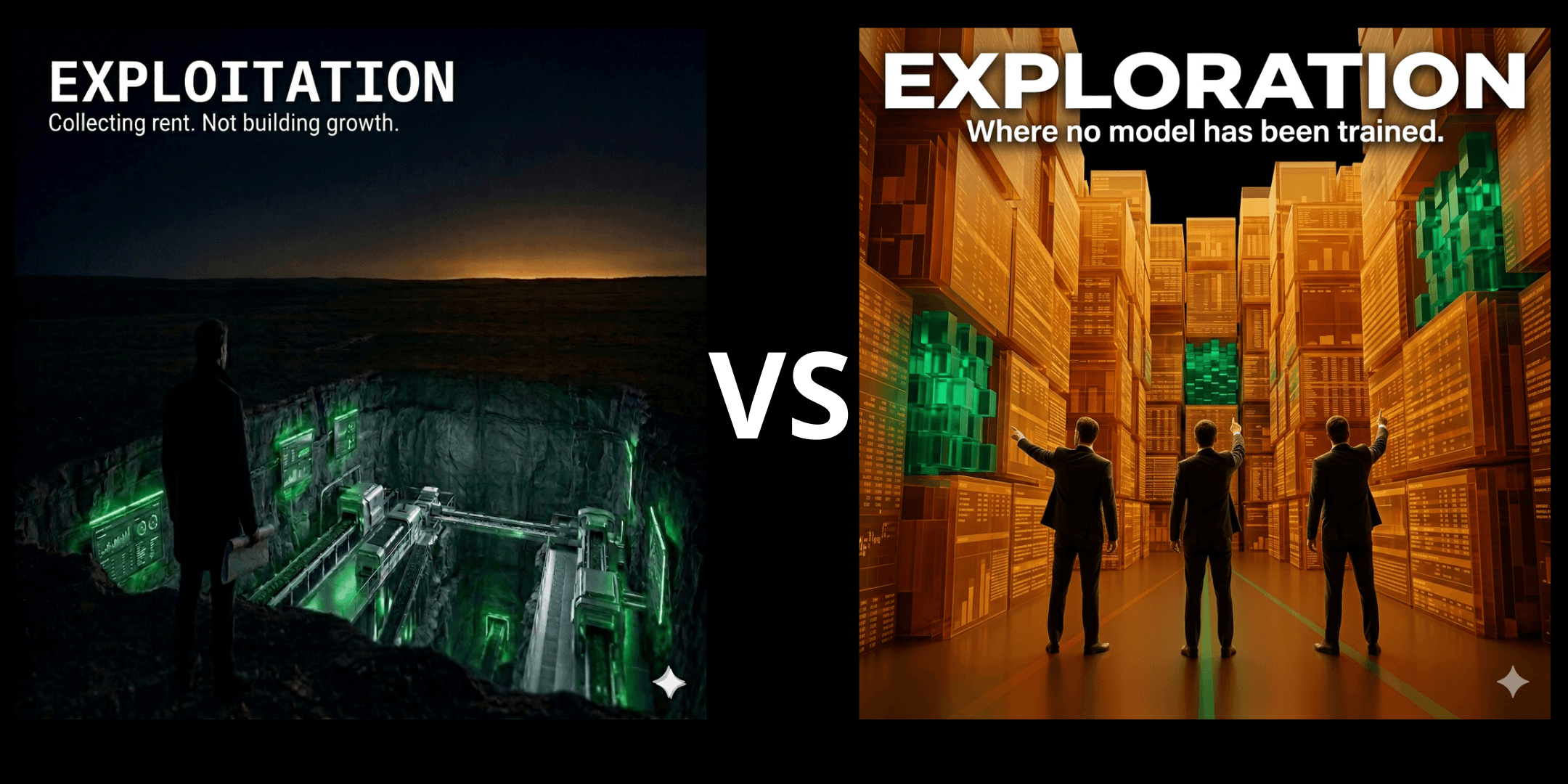
𝗬𝗼𝘂𝗿 𝗔𝗜 𝗶𝘀𝗻'𝘁 𝗴𝗿𝗼𝘄𝗶𝗻𝗴 𝘆𝗼𝘂𝗿 𝗯𝘂𝘀𝗶𝗻𝗲𝘀𝘀. 𝗜𝘁'𝘀 𝗺𝗮𝗻𝗮𝗴𝗶𝗻𝗴 𝘆𝗼𝘂𝗿 𝗽𝗮𝘀𝘁 — 𝗮𝘁 𝘀𝗰𝗮𝗹𝗲.
We've been asking the wrong question about AI.
The question isn't whether the model works.
The question is what the organization has been optimizing for — and for how long.
📐 Thomas Piketty described a structural law of capitalism: r > g. Return on accumulated capital grows faster than the economy itself.
Applied to commercial AI, the translation is precise: return on existing data — your win rates, your best accounts, your historical patterns — now grows structurally faster than your capacity to open new markets.
The technology doesn't cause this. It accelerates what was already the path of least resistance.
The result has a name: algorithmic rent-seeking.
The organization that invests in AI to optimize what it already knows is not building competitive advantage. It's extracting yield from accumulated data — efficiently, precisely, at scale. It's a rentier. And like all rentiers, it mistakes income for growth.
⚖️ James March identified the organizational death spiral fifty years ago: companies die from too much exploitation and too little exploration.
Refining what works, eliminating variance, optimizing what's known. The algorithms didn't create this tendency — they industrialized it. What once required a conscious decision now happens by default, at machine speed, across every account.
The cost isn't visible in this quarter's P&L. It accumulates in what the organization stops being capable of: entering markets first, identifying needs before they become obvious, adapting to demand that no dataset has seen yet.
Exploration is not a strategic luxury. It's the only mechanism that lets an organization reinvent itself before the market forces it to.
Leadership in this environment isn't about making the AI work harder.
It's about deciding when to ignore it — deliberately — to force exploration into territory the model has no data for.
That requires a different organizational design:
❌ Not teams that execute processes.
✅ Teams that audit algorithms — not to validate what the model says, but to rescue what it ignores.
A culture that rewards the detection of patterns that don't fit. Where the anomaly is the signal, not the noise.
The uncomfortable answer to the question this series started with — who in our organizations is paid to notice the geometry? — is: usually no one. The geometry is what the algorithm optimized away.
Unpopular opinion: most AI governance frameworks protect existing revenue. None protect the capacity to explore. Those are not the same objective — and confusing them is how a market leader becomes irrelevant.
Is your organization designed to explore — or is it a data rent management office running at scale?
The organizational answer to #TheParetoCollapse — part 3 of 3.
#TheParetoCollapse #BusinessDevelopment #AIGovernance #CommercialStrategy #DataDriven #ContinuousLearning #OriacGimeno