
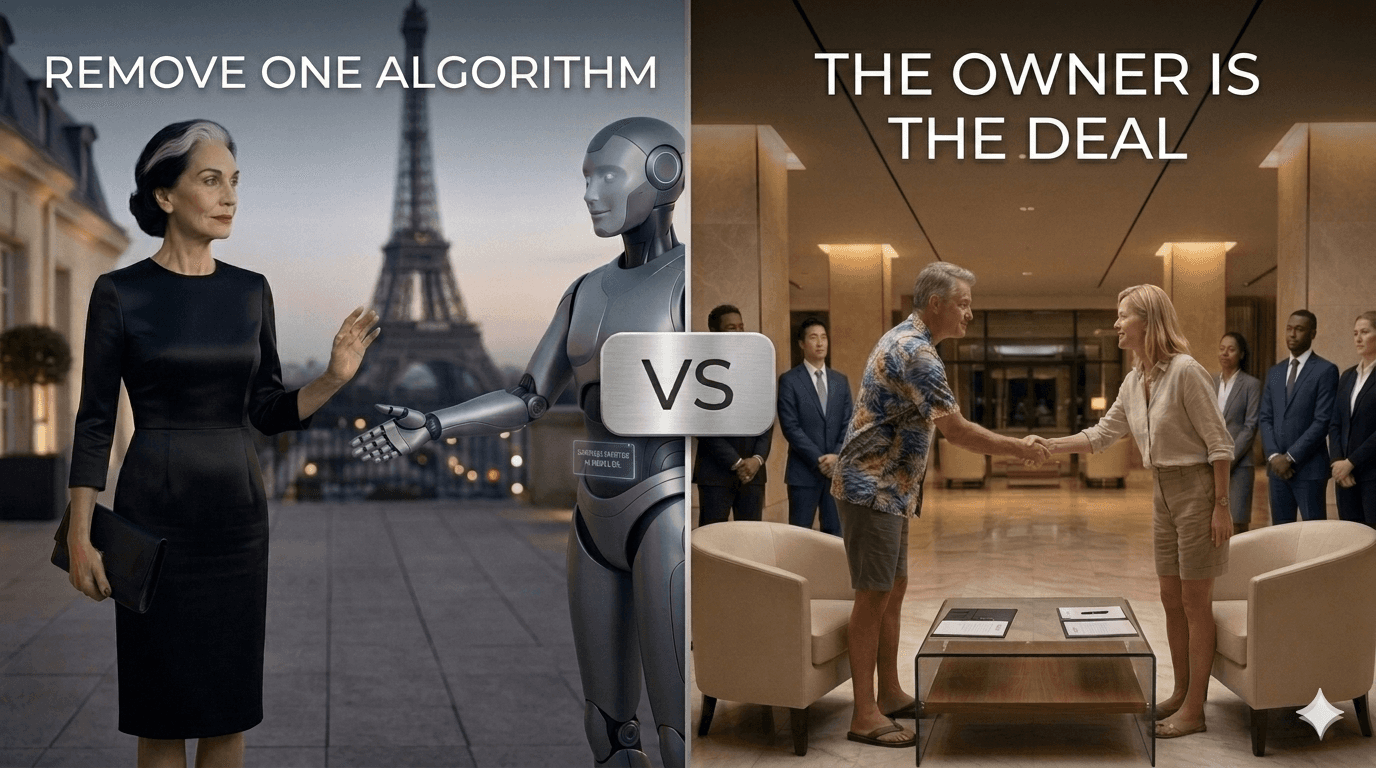
#TheConvergenceTrap — REMOVE ONE ALGORITHM
Nobody closes a $10M deal wearing a tracksuit.
Nobody except the owner — because the owner IS the deal.
Coco Chanel's rule wasn't about fashion. It was about discipline: before you leave, look in the mirror and remove one accessory. The luxury isn't in what you add. It's in knowing what to take away.
In 2026, most companies do the opposite with AI. Each new layer individually justified. Together, they produce something Chanel would have recognized immediately: too much. And too much, in any context, reads as insecurity — not sophistication.
✅ The risk is no longer hallucinated data — it's hallucinated judgment.
GPT-5.5 doesn't say 2+2=5. It's eloquent, logical, and dangerously reasonable. A captain who has read every storm ever sailed — but never felt cold asphalt under a wheel. It knows where the curve is. It doesn't know if the road is wet. In a negotiation under pressure, that gap isn't technical. It's the margin.
✅ When everyone buys the same tokens, strategies synchronize. Ethan Mollick confirmed it in 2026: moats no longer live in the model's output — they live in what it can't touch. Same data, same training logic — proposals converge and buyers receive identical outreach from five competitors on the same day.
At B2BMX 2026, Christopher Rack — $14,000 per employee to protect organizations from their own models. The human in the loop isn't there to correct the AI. They're there to introduce the one asymmetry no competitor can replicate with the same tokens: the proprietary context built inside a real relationship.
✅ AI can simulate empathy. It cannot hold accountability. When a model discards a client or costs a strategic relationship — nobody loses their bonus. Nobody reviews the call. No skin in the game: a system without consequences doesn't just fail — it optimizes toward error, because no one pays the price. The owner closes in a tracksuit because they carry what no model ever will: full exposure to the outcome. That's what "less is more" means in commercial strategy — returning the moment of judgment to the human. Not the processing. The judgment.
The scarcest competitive asset in 2026 isn't the model you run. It's knowing which part of the process cannot be the model — and protecting it.
Unpopular opinion: most AI adoption roadmaps are written to justify investment already committed — not to identify where the model is eroding the differentiation it took years to build.
That's not a technology problem. It's a governance problem dressed as a roadmap.
If your commercial proposal is indistinguishable from what a model trained on the same public data as your competitor produces — you don't have a proposal. You have the market average packaged with your logo.
In which part of your commercial process did AI take control — and was that a deliberate decision, or did it just happen?
#TheConvergenceTrap #TheParetoCollapse #AIGovernance #DataTranslator #CommercialStrategy #OriacGimeno