
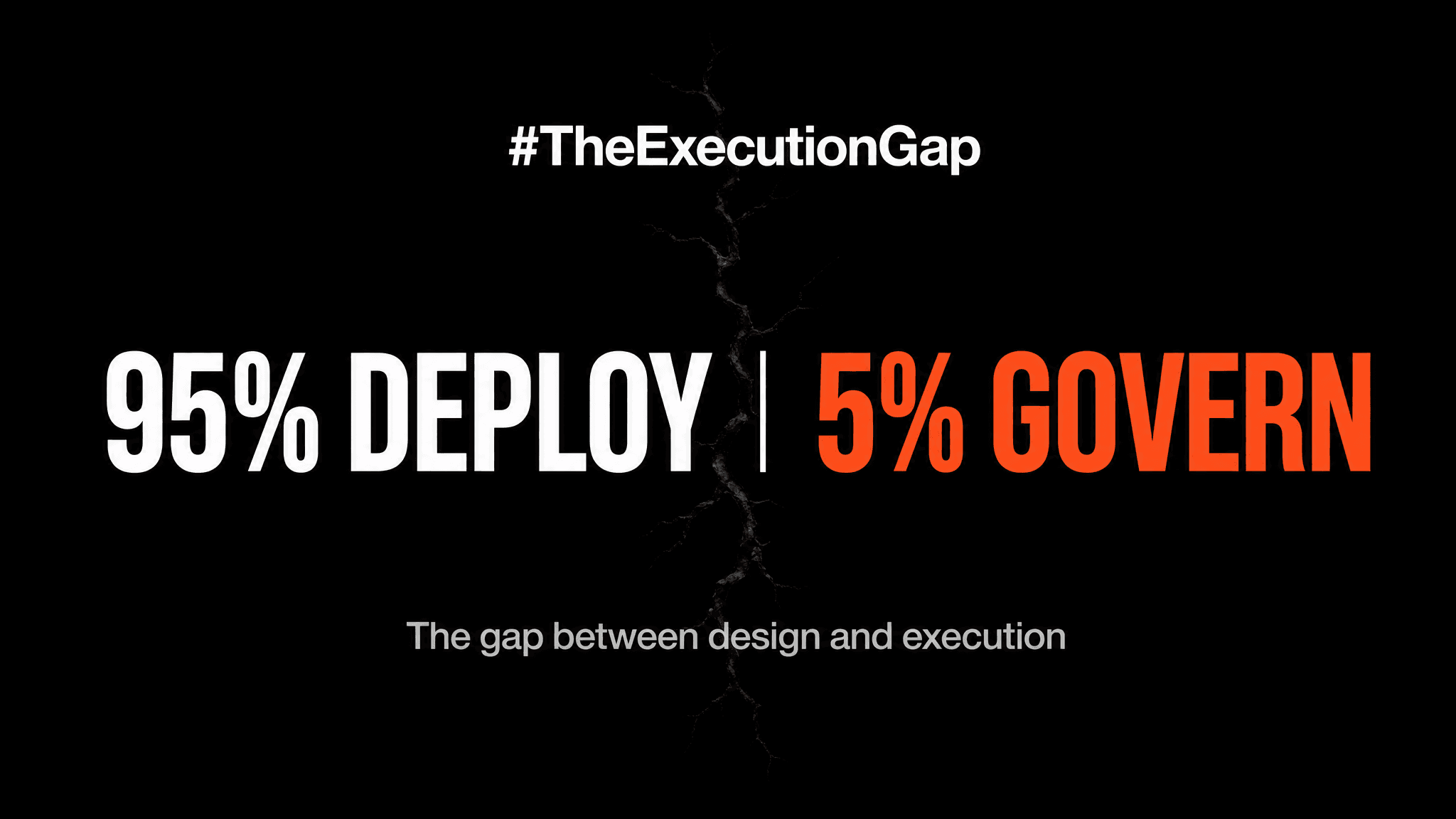
#TheExecutionGap 95% OF ORGANIZATIONS DEPLOY AI. 5% CAN GOVERN IT.
Most organizations measure AI adoption.
Nobody measures what they lose when the model breaks.
#ThePlannedDependence ended with a question. This is where #TheExecutionGap begins.
Companies deploy AI faster than they build the capacity to govern it. Not the technical capacity. The commercial and structural capacity to know when the model is wrong, absorb the error, and recover without collateral damage.
Donald Sull, Rebecca Homkes and Charlie Sull documented it for strategy: 2/3 to 3/4 of large organizations fail not because the plan was wrong, but because they never built the infrastructure to execute it when conditions changed. Boston Consulting Group (BCG) confirmed the same for AI in 2025: only 5% generate substantial value.
Deploying and governing are the same gap. It has three commercial manifestations.
✅ Digital Transformation is not a software problem.
It is the distance between a tool the organization bought and a capability it actually runs. Licenses get renewed. Adoption stays flat. The tool becomes infrastructure for workflows that existed before it arrived.
No governance layer owns that gap.
✅ Commercial Excellence breaks at the revenue layer.
Not because the strategy was wrong. Because the system that executes it, segmentation, pricing, incentives, produces outputs no one validates against outcomes. AI accelerates the volume. It does not fix the design.
When the design is wrong, it amplifies the error at scale before anyone notices.
✅ Go-to-Market architecture fails silently.
The model was built for a different context. It gets copied into new markets, new channels, new buying centers. It runs. It produces results that look like the past.
Nobody asks if the past is the right benchmark.
Three domains. One mechanism.
The environment changes faster than the model. The model keeps running. The gap between what it assumes and what the business faces grows invisibly, until it becomes a revenue, market share, or governance crisis.
The organizations that close this gap are not the ones that deploy AI first.
They are the ones that build, deliberately, the layer between what AI produces and what leadership decides.
Governance does not slow the business down. It keeps the business from becoming a high-speed execution of an assumption nobody validated.
Over the next weeks, this series explores one idea: execution fails long before organizations realize it; why, how to recognize it, and what to do about it.
Most AI strategies end at deployment. What happens when the model drifts, or fails confidently in a new context, is treated as an edge case. It is not. It is the governance question no business was designed to answer.
If your organization decided to adopt AI, who owns the decision of when to override it?
The gap between design and execution. #TheExecutionGap
#AIGovernance #CommercialStrategy #DigitalTransformation #RevOps #GoToMarket #OriacGimeno