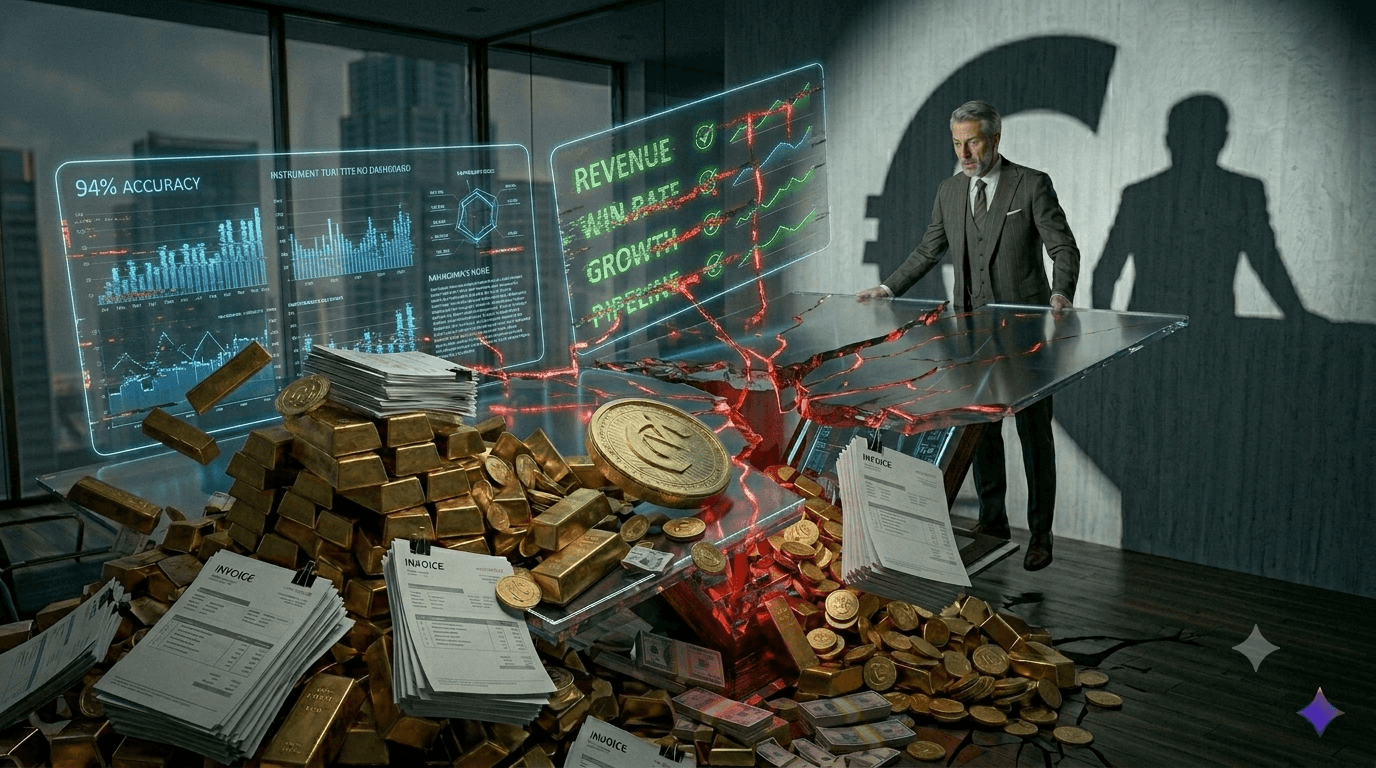
#TheTokenTax: THE NEXT AI CRISIS WON'T BE TECHNICAL. IT WILL BE FINANCIAL.
Your AI works.
Your business case doesn't.
Most companies still treat AI like software. A seat, a rollout, a monthly flat fee.
That framing is already obsolete. Once AI moves from occasional prompting to integrated agents, reasoning chains, and autonomous coding, it stops behaving like SaaS and starts behaving more like IaaS: variable infrastructure whose cost scales with consumption.
The model may impress.
The invoice decides whether it belongs in the operating model.
✅ Token spend is not a technical footnote. It is governance.
When Microsoft recently cut internal Claude Code licenses to redirect teams toward GitHub Copilot, the signal was not that the tool had failed. It was that uncontrolled consumption had collided with financial reality. When Uber exhausted its annual AI coding budget in just four months, the problem was not lack of adoption. It was a lack of economic design.
These organizations didn't have a technical crisis.
They had a scale crisis.
✅ Lower unit costs do not solve the real problem.
Unit cost per token will fall, but total spend will explode as context windows grow and agents become more talkative to solve complex tasks. Growth in volume always outpaces drops in price.
The question stops being an IT question and becomes a governance one:
Who gets access?
Which decisions justify frontier intelligence?
What approval logic governs consumption?
When the unit economics no longer justify the cost?
✅ Human judgment is the final filter in a multi-model world.
Not every task deserves a frontier model, the same cost, or the same level of autonomy. In my own daily workflow, I switch between different systems, from Claude and ChatGPT to DeepSeek, Gemini, Copilot or Abacus.AI, simply because the trade-off between depth, speed, cost and creative reliability is never fixed. The line between automation and oversight is a moving target that no default software setting can solve.
The real skill is not access to the tools. It is the judgment required to assign the right intelligence to the right problem at the right cost.
The companies that scale AI effectively will not be those using one model everywhere. They will be the ones that learn how to route work deliberately across different tools, risk levels, and price points. The next massive failure in business will not be a bad prompt. It will be successful adoption with no allocation logic.
The real moat in enterprise AI will not come from having the best model. It will come from knowing which decisions deserve frontier intelligence, which need process discipline, and which should never leave human hands.
Who in your company is currently designing the boundary between AI automation, cost-efficiency, and non-negotiable human judgment?
AI stopped being a software decision.
It became a capital allocation decision.
#AIGovernance #AIStrategy #CommercialExcellence #DigitalTransformation #OriacGimeno